
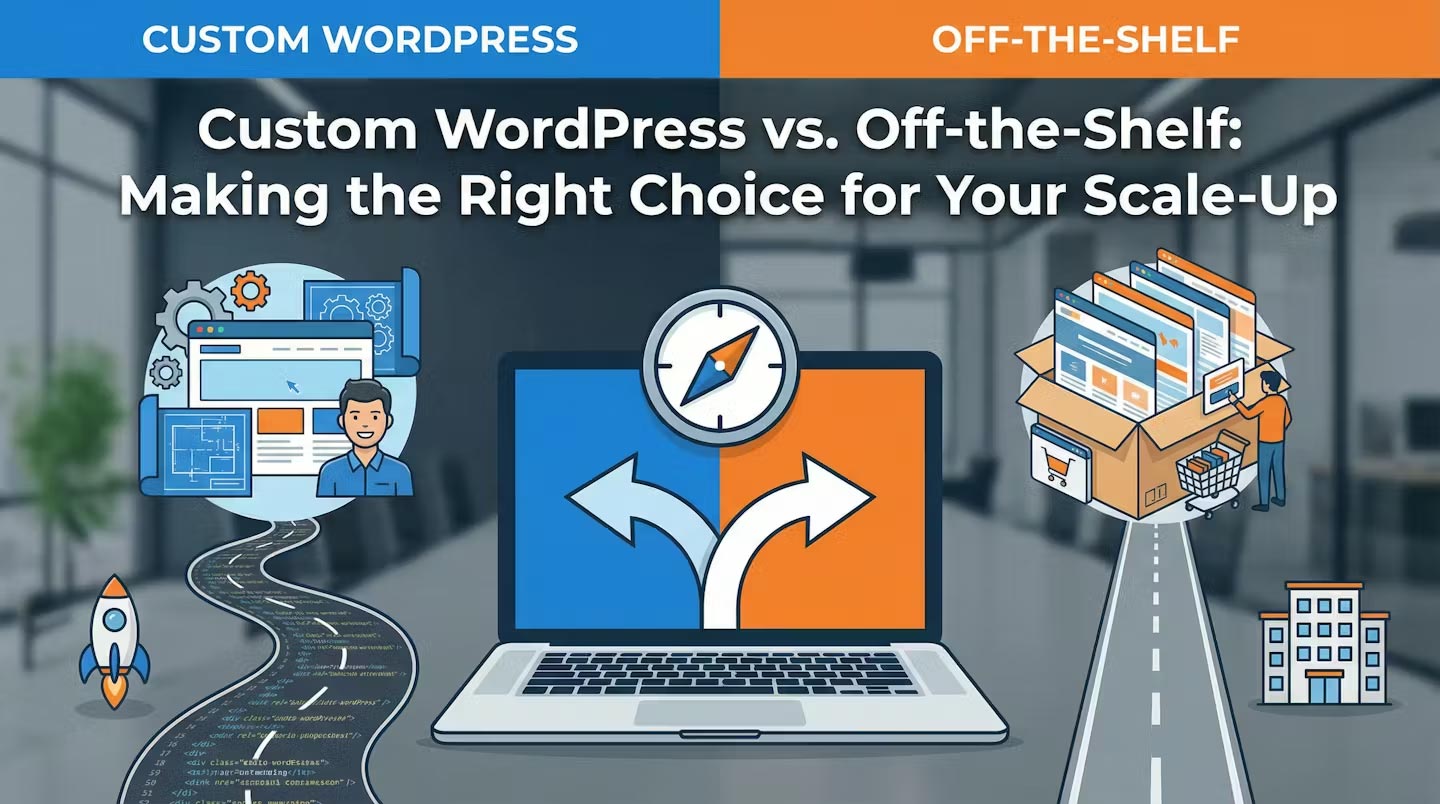
You’ve hit that sweet spot. Product-market fit is locked in. Traffic is climbing every month.
But there is a problem. Your website is starting to crack under the pressure.
The WordPress site that got your business from zero to your first half-million was great for what it was. It did the job. But the setup that got you here won't get you to the next level.
Sound familiar?
I see this happen all the time. A scaling UK business comes to me because their site is dragging. It takes ages to load. The marketing team is terrified to update the homepage just in case the whole thing completely breaks.
Usually, the culprit is an off-the-shelf theme packed with a heavy page builder like Elementor, Divi, or Avada.
I’ll be honest. I really dislike page builders.
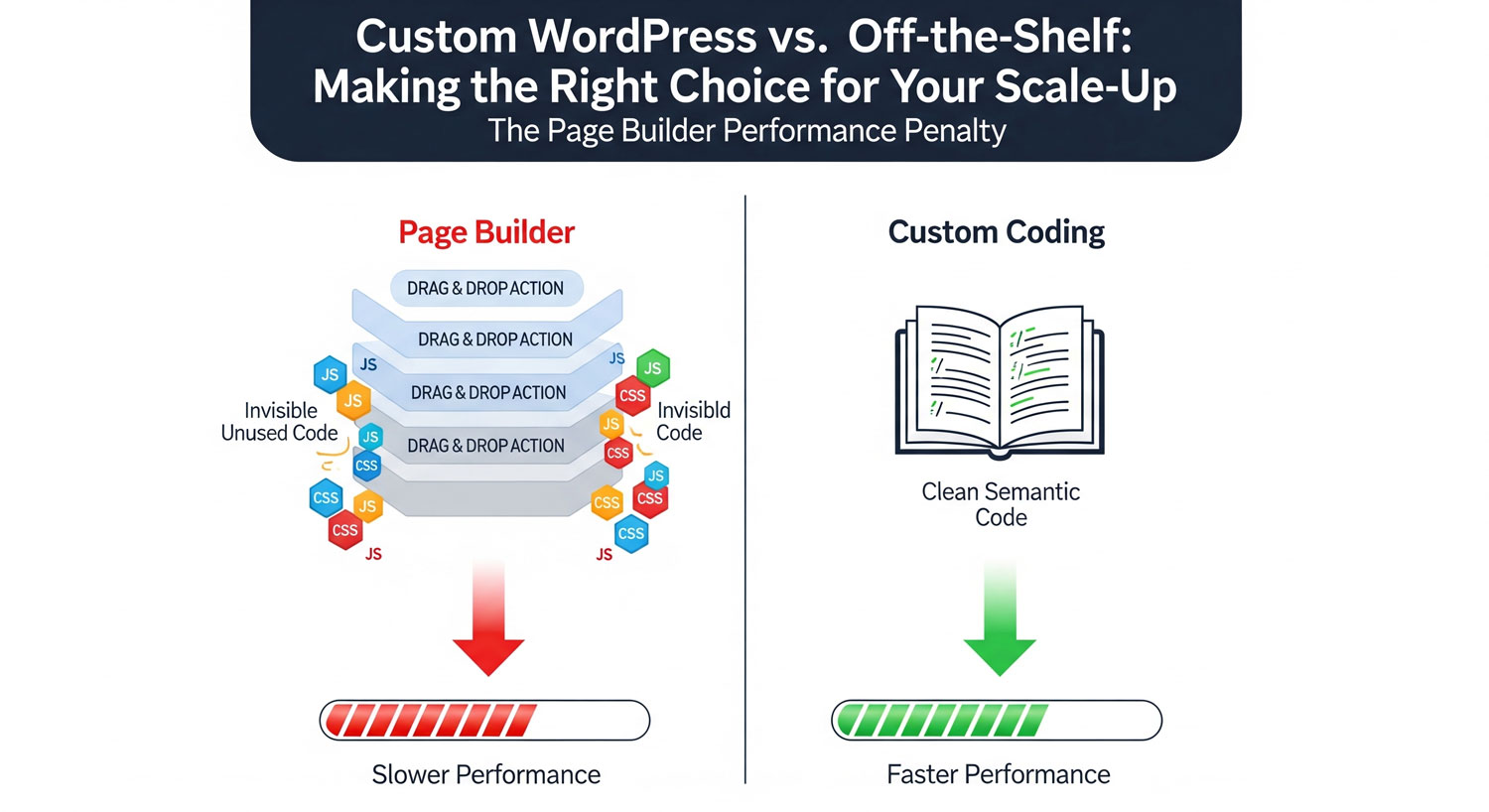
They dump a massive load of unused JavaScript and CSS onto every single page. It absolutely kills your site speed.
And it gets worse. These pre-built themes rely heavily on a tangled web of third-party plugins just to function. The theme developer bundles in 15 different plugins just to make their sales demo look good.
But what happens six months down the line?
One plugin updates, conflicts with another, and suddenly your contact page is completely blank.
I have had to step in and rescue so many sites simply because their theme was a ticking time bomb of plugin dependencies. The theme breaks because a plugin stops working. The cycle is endless and incredibly frustrating for business owners.
A good website shouldn't feel fragile.
My philosophy is simple. A solid WordPress theme should rely on its own clean code. That’s it.
You only really need a handful of complimentary plugins to run a highly successful site. Things like Yoast for SEO, maybe JetPack, a solid caching setup if you aren't using Cloudflare, and Contact Form 7. I've used Contact Form 7 for over 15 years. Why? Because it is incredibly lightweight and it just works. Without fail.
So, you are at a crossroads.
Do you keep patching up a bloated, off-the-shelf theme? Or do you invest in a custom-coded, bespoke WordPress site built specifically for your scale-up?
Let's break down exactly why leaving those generic templates behind is the best move for your growing business.
The Allure (and the Trap) of Off-the-Shelf Themes
Look, I get it. When you first start out, a £50 theme from ThemeForest looks like an absolute steal.
You install it, click "import demo data", and suddenly you have a full website. It makes total sense when budgets are tight and you just need to get your business online fast.
But here is the catch.
Those pre-built themes are designed to sell to as many people as possible. A single theme has to work for a plumber in Manchester, a yoga studio in London, and a tech scale-up in Birmingham.
To make that happen, the theme developers throw in absolutely everything.
They pack it with sliders, complex portfolios, pricing tables, and countdown timers. It is the classic "kitchen sink" problem.
And to let users customize all this without knowing how to code, they bundle in heavy page builders like Elementor, Divi, or Avada.
That convenience comes at a massive cost.
If you only actually use 5% of the theme's features, your website still loads the other 95% of the code in the background. Every single time someone visits your site, their browser has to download megabytes of junk JavaScript and CSS they will never even see.
It completely tanks your site speed.
Then there is the plugin bloat. You buy a theme, activate it, and instantly get a massive warning at the top of your dashboard. It forces you to install a dozen "required" plugins just to make the basic navigation menu work.
Heavy plugins like Slider Revolution are bundled in, slowing your site down to a crawl before you have even added your own content.
It feels like a great deal on day one. Fast forward a year, and your site is a complete nightmare to manage.
You run a simple WordPress update, and the whole layout shifts. You try to add a new landing page, and a plugin conflict leaves you staring at a blank screen.
The real trap is thinking this is just how WordPress works.
It isn't. It is just how cheap WordPress works.
What "Custom WordPress" Actually Means in 2026
People hear "custom coded" and panic.
They think it means they will be locked out of their own website. They worry they will have to email me every time they need to change a simple comma or swap out a team photo.
Maybe that was true ten years ago. It isn't today.
So what does a bespoke WordPress site actually look like in 2026?
It means total freedom for your marketing team.
We completely rip out those heavy page builders. We bin Elementor and Divi. Instead, we lean heavily into the native WordPress editor—Gutenberg.
But we don't just leave you with the default setup. I build bespoke Gutenberg blocks tailored exactly to your brand guidelines.
Need a specific layout for a new product feature? Or a unique case study grid? I code the block from scratch.
Your team just drops it onto the page, types in the text, and uploads an image. It looks pixel-perfect every single time.
No messing around with padding. No accidentally dragging a column to the wrong side of the page and ruining the layout. You literally cannot break the design.
Under the hood, it is a completely different world from off-the-shelf themes. We build using clean, modern PHP 8+ and vanilla JavaScript.
There are no massive third-party libraries loading in the background just in case you might use a fancy slider one day. We only write the exact code your website actually needs. Nothing more.
The result? A site that feels incredibly fast to edit.
Your team can spin up high-converting landing pages in minutes. No developer required for day-to-day changes. Everything stays perfectly on-brand, and the codebase stays incredibly light.
It is the exact opposite of the bloated, fragile mess you are probably used to.
Performance and SEO: The Growth Engines
Let's talk about Google for a second.
Google hates slow websites. Your customers hate them even more.
When you use an off-the-shelf theme packed with a heavy page builder, you are fighting a losing battle with SEO.
Why? Because page builders generate a massive amount of messy code. Divi and Elementor spit out div after div after div just to place a simple line of text on the screen.
Search engines have to crawl through all of that junk just to figure out what your page is actually about.
That is terrible for your Core Web Vitals.
Are your Core Web Vitals dragging down your SEO?
Get a Free Performance AuditHave you checked your site speed lately?
If your website takes more than a couple of seconds to load, people just bounce. They click the back button and go straight to your competitor.
In the UK market right now, milliseconds literally cost you money. If your lead form or checkout lags even slightly, you lose the conversion. It really is that simple.
Now look at a custom-coded WordPress site.
When I build a bespoke theme, I use clean, semantic HTML.
What does that actually mean?
It means the code speaks directly to search engines. I use the exact right HTML tags in the exact right order. There is no bloated wrapper code. No messy nested columns created by a drag-and-drop builder.
Google bots crawl the site instantly. They understand your content perfectly.
And because we aren't loading megabytes of unused JavaScript from twenty different plugins, your pages load in a flash.
Your Core Web Vitals turn green. Your bounce rate drops.
You get a massive, built-in SEO advantage from day one. You don't have to spend a fortune on technical SEO audits trying to fix a broken foundation.
The foundation is already solid.
Brand Identity & The User Journey
Have you ever clicked on a website and instantly thought, "I know this template"?
I see it all the time.
That is the major flaw with off-the-shelf themes. Thousands of other companies bought the exact same £50 download. They just swapped the demo logo for their own and changed the accent colour from blue to green.
It makes your brand look totally generic. You look like a brand new startup just testing the waters, not a serious business scaling up.
But the real issue goes much deeper than just looking a bit samey.
When you use a pre-built template, you force your content to fit into their pre-defined boxes.
If the theme has a section for three short bullet points, you have to write three short bullet points. Even if your product actually needs a detailed, step-by-step diagram to make sense.
You compromise your own sales pitch just so the page layout doesn't break.
That is completely backwards.
Design must follow content. Your message always comes first.
When we build a custom WordPress site, we start with your actual customers. What exactly do they need to see before they trust you enough to buy? What journey do they take from the homepage to your checkout or contact form?
I design and code the website around that specific journey.
If your users need an interactive pricing calculator, I build it. If you need a completely unique portfolio layout to show off your work, we create it from scratch.
No forced layouts. No awkward empty spaces because you didn't have enough text to fill a demo block.
Your website finally looks and behaves exactly like your brand.
Security & Scalability
Let’s talk about the absolute nightmare of a hacked website.
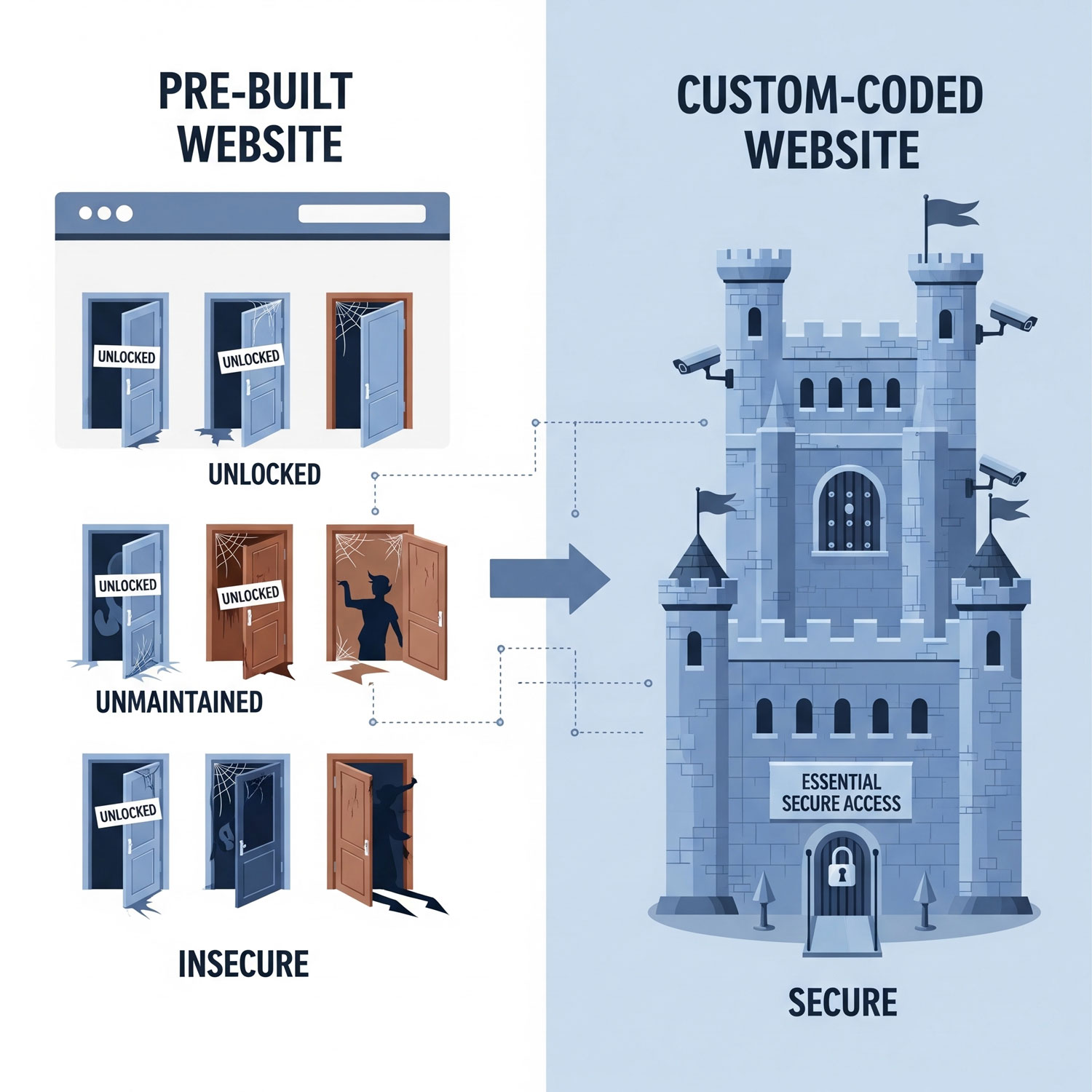
When you buy a generic theme, it usually forces you to install 15 or 20 different third-party plugins just to make the basic features work.
Every single one of those plugins is a potential open door for hackers.
What happens if the developer of that random slider plugin you never even wanted stops updating it? Hackers eventually find a vulnerability. They exploit it. Suddenly, your homepage is redirecting to a dodgy website, or worse, your customer data is at risk.
I've taken frantic phone calls from business owners dealing with exactly this. It completely destroys the trust you have built with your audience.
With a custom-built WordPress site, we drastically reduce your attack surface.
Because we don't rely on a massive stack of bloated plugins to hold the design together, there are simply fewer doors to lock. I only use the absolute essentials. The core functionality you actually need is securely hard-coded straight into your bespoke theme.
Then there is scalability.
Imagine you run a huge marketing campaign. Maybe you get a mention in the national press or you launch a massive Black Friday sale. Thousands of people hit your site at exactly the same time.
An off-the-shelf theme packed with heavy page builders will panic.
Your server has to process thousands of complex database requests just to load the messy Divi or Elementor header. The site slows down to an absolute crawl. Eventually, it just crashes completely.
You lose the exact sales you just worked so hard to get.
A custom theme handles those sudden traffic spikes effortlessly. The code is incredibly light. Your server isn't wasting precious resources trying to figure out which of the 50 unused scripts it needs to load. It just serves the page to your users instantly.
Your site stays online, fast, and completely secure.
The True ROI (Total Cost of Ownership)
Let’s address the elephant in the room.
A custom WordPress website costs more upfront than a cheap pre-built template. That is just a fact.
But you really need to look at the total cost of ownership.
I talk to founders all the time who bought a cheap theme to save money. Then they spent three weeks trying to make the demo look right. Then they hired a freelancer to fix a plugin that broke the checkout. Then they lost countless sales because the site took six seconds to load on a mobile phone.
That is called technical debt. You always end up paying for it eventually.
Every single hour your marketing team spends wrestling with a clunky page builder is an hour they aren't actually marketing your business. Every customer who bounces because your site is too slow is lost revenue.
When you invest in a bespoke site, you pay once for a rock-solid foundation.
You don't need to tear it down and rebuild it in 18 months because it collapsed under its own weight. It just runs smoothly in the background while you focus on scaling your business.
The return on investment isn't just in the clean code. It is in the time your team gets back. It is the higher conversion rates from a blazing fast site. It is the absolute peace of mind knowing your website won't crash when your biggest campaign goes live.
Ready for a Website That Actually Performs?
It comes down to a very simple choice.
You can keep fighting with bloated page builders and praying your third-party plugins don't break during a busy week. Or you can graduate to a website that actually matches the ambition of your scale-up.
If you are serious about growing your UK brand, you need a digital presence built for performance, security, and speed. No shortcuts. No bloat.
If you are ready to ditch the off-the-shelf trap, let's have a chat about what a custom WordPress theme can actually do for your business.
Tell me a bit about your project and I'll get back to you within 24-48 hours with some honest thoughts on how we can help.